What is it?
The aerobrakes are a subsystem of the RMIT Rocket, Aurora V. This rocket has been entered into the 2024 Australian Universities Rocket Competition (AURC). The main objective of the aerobrake subsystem is to slow the rocket down to reach a precise altitude of 10,000 ft at apogee. This is achieved through surfaces deploying perpendicular to the airstream to induce drag. My work has primarily been involved in the structural aspect of the project, such as the mechanism and coupler design.
Aerobrakes location
The image below depicts the location of the aerobrake subsystem. The coupler acts as an attachment point between the upper and lower airframe of the rocket. The airframe structures slide onto the coupler and are bolted in place.

Prototyping & Brainstorming
Prototyping was a huge part of the design process. Each design iteration was 3D printed to verify functionality, packaging and integration. The whiteboard was used extensively to brainstorm possible solutions. This aided in providing a bird's eye view perspective, avoiding tunnel vision and enabling the team to make better decisions.


Final Design
After countless iterations, the final design was developed. Structurally, the assembly passed all the initially specified objectives and constraints.
-
The mechanism deployed and retracted the surfaces smoothly, with the integrated aerobrakes electronics.
-
The given target masses were achieved, with the assembly weighing 2.8kg in total.
-
Bolt calculations, FEA, static, dynamic and flight testing were completed to verify the structure could sufficiently handle the load cases.
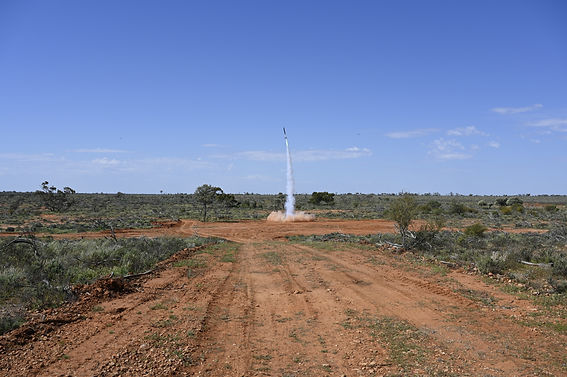
One of the test rockets, Aurora III was launched on the 7th of July 2024. This was the first aerobrakes integrated RMIT rocket, which successfully remained intact with no visible damage post-launch. Aurora IV and Aurora V flew later that year. In the last flight, the aerobrakes were tested (with a basic version of the algorithm) and the aerobrakes successfully deployed in flight.