
Forged Carbon Fibre Aerobrake Surfaces
Skills
-
Mould preparation
-
Resin to fibre mass calculations
-
Process optimisation
Objectives
-
Improve method for repeatability
-
Minimise defects such as voids, dry spots and geometrical deformities
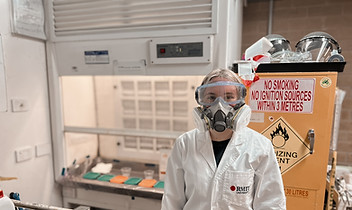
Here is a picture of me during mould preparation. I became very good at this process because of the many mould design iterations that we completed.

Overview
This project was focused on the design and manufacturing of forged carbon fibre aerobrake surfaces. Forged carbon parts are essentially cut-up carbon tows that are saturated with resin and tightly compressed into a mould until fully cured. My team and I worked on the optimisation of the mould design and manufacturing process. Visual inspection was used as the method to assess the part quality.
Component to be manufactured
The aerobrake surfaces belong to the aerobrake subsystem assembly. This component's main function is to deploy into the airstream and generate drag, to slow the rocket down. The holes are used as attachment points to connect the surfaces to the linkages and linear bearings.


Surfaces need to be strong
These surfaces must successfully withstand and transfer the loads generated by drag to the linear rails and coupler, whilst minimising bending to ensure complete retraction. Therefore, preventing deformation is crucial. To obtain the mechanical properties needed to withstand this load, the manufacturing process must be finetuned to produce surfaces without visible defects, in a reliable manner. The image below shows a visual representation of the load case that the surfaces will experience in-flight at deployment.

Why Forged Carbon Fibre?
The aerobrake surface was chosen to be made of forged carbon fibre. This decision was made for several reasons and are listed below.
-
Forged carbon fibre has a high strength-to-weight ratio and a low coefficient of thermal expansion. This makes the material highly beneficial for high-temperature applications where precision is critical.
-
Parts can be made in-house. This reduces reliance on external manufacturers, thereby ensuring parts can be manufactured on time.
-
Manufacturing is inexpensive, due to the low cost of materials and no requirement of costly tooling.
-
It's an excellent learning experience for students.
Result
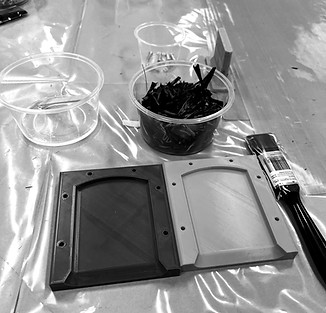
After countless iterations, the team developed a refined manufacturing method to produce reliable, simple and defect-free surfaces.
Specifications of the latest manufacturing process:
-
100% infill 3D printed PLA moulds.
-
Kinetix resin to ensure surfaces can withstand the high temperatures experienced during flight.
